
 Video
Video

The Ultimate Torque Conversion Guide: Understanding N.m, Ft-lb, and In-lb
Summary
In this article, you will learn:
- The fundamental differences between N.m, Ft-lb, and In-lb torque units
- Why torque conversion errors lead to costly industrial failures
- Practical torque conversion tables commonly used in global industries
- How dual-scale mechanical torque wrenches reduce human error on the shop floor
Precision Is Not Optional in Industrial Operations
In the high-stakes world of heavy industry, automotive assembly, and aerospace manufacturing, precision is not a luxury—it is a requirement.
A fastener tightened to an incorrect torque specification risks not only component failure, but also operator safety, production downtime, and long-term reliability.
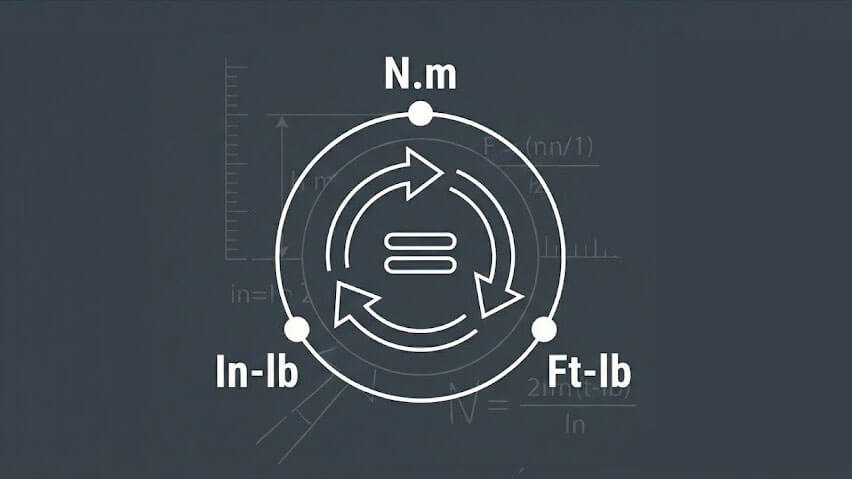
For procurement officers and industrial technicians operating in a global supply chain, torque specifications often appear in multiple unit systems. Machinery from Europe uses Metric units (N.m), equipment from the United States specifies Imperial units (Ft-lb), while precision assemblies frequently rely on inch-pounds (In-lb).
At Torque-Tech Precision, we believe operational excellence begins with clarity. This guide explains how torque units differ, how to convert them accurately, and why selecting the correct mechanical torque wrench bridges theory and real-world application.
The Global Language of Torque: Understanding the Units
Torque is a rotational force—the controlled clamping energy that holds mechanical systems together. Before applying conversion charts, it is essential to understand what each unit represents.
Newton Meter (N.m) – The International Standard
The Newton Meter is the SI (International System of Units) measurement for torque and is widely used in Europe and Asia.
Definition:
The force of one Newton applied perpendicularly at the end of a one-meter lever arm.
Best suited for:
General industrial machinery, modern automotive engines, and heavy equipment.
Foot-Pound (Ft-lb) – The Imperial Workhorse
The Foot-Pound is the dominant torque unit in the United States and remains standard in many legacy industries.
Definition:
The force of one pound-force applied at the end of a one-foot lever arm.
Best suited for:
U.S.-manufactured equipment, construction machinery, and structural applications.
Inch-Pound (In-lb) – Precision Applications
For low-torque and delicate assemblies, inch-pounds provide greater resolution than foot-pounds.
Definition:
The force of one pound-force applied at the end of a one-inch lever arm.
Best suited for:
Electronics, bicycle components, small engines, and precision instrumentation.
Why Accurate Torque Conversion Is Non-Negotiable
The “Close Enough” Trap
Torque units are not interchangeable. For example, setting a wrench to 100 Ft-lb when the specification requires 100 N.m results in approximately 35% over-torque.
Consequences include:
- Stripped threads
- Bolt head failure
- Hidden metal fatigue leading to catastrophic failure during operation
Global Manufacturing Complexity
Modern production environments often mix equipment and tooling from multiple regions. Without accurate conversion—or without dual-scale torque tools—human error becomes inevitable.
Reliable conversion knowledge and clearly marked mechanical torque wrenches are the first line of defense against costly operational risks.
The Ultimate Torque Conversion Tables
| CONVERT FROM | TO | MULTIPLY BY |
| ozf-in | lbf-in | 0.0625 |
| lbf-in | ozf-in | 16 |
| lbf-in | kgf-cm | 1.1519 |
| lbf-in | lbf-ft | 0.083333 |
| lbf-in | kgf-m | 0.011519 |
| lbf-in | N-m | 0.1130 |
| lbf-in | dN-m | 1.130 |
| lbf-ft | N-m | 1.356 |
| lbf-ft | kgf-m | 0.1382 |
| lbf-ft | lbf-in | 12 |
| N-m | dN-m | 10 |
| N-m | kgf-cm | 10.20 |
| N-m | kgf-m | 0.10197 |
| N-m | lbf-in | 8.8507 |
| N-m | lbf-ft | 0.73756 |
| dN-m | lbf-in | 0.885 |
| dN-m | N-m | 0.100 |
| kgf-cm | lbf-in | 0.8681 |
| kgf-cm | N-m | 0.09807 |
| kgf-m | lbf-ft | 7.233 |
| kgf-m | N-m | 9.807 |
Procurement Tip:
Selecting a dual-scale mechanical torque wrench eliminates the need for manual calculation and significantly reduces operator error.
Why Mechanical Torque Wrenches Still Dominate Industry
Reliability in Harsh Environments
Mechanical torque wrenches operate without batteries or electronics, making them highly reliable in oily, dusty, or high-impact environments.
Tactile and Audible “Click” Feedback
Click-type torque wrenches provide immediate sensory confirmation when target torque is reached—critical in noisy or low-visibility conditions.
Dual-Scale Readability
Laser-etched, dual-scale markings allow operators to work seamlessly with Metric and Imperial specifications using a single tool.
Frequently Asked Questions (FAQ)
To further assist you in navigating torque conversions and tool selection, we have answered the most common questions frequently asked by maintenance teams and procurement officers.
Q1: Is 100 Nm equal to 100 ft-lb?
A: No. 100 Nm is approximately 73.75 ft-lb. Treating them as 1:1 is a dangerous error that leads to significant over-tightening (if using ft-lb for a Nm spec) or under-tightening (if using Nm for a ft-lb spec).
Q2: Why is a manual torque wrench preferred for heavy duty sites?
A: Manual wrenches are preferred because they are durable, require no power source, and are less susceptible to damage from drops, oil, or water. For remote sites or heavy industrial use, the mechanical simplicity ensures the tool is always ready to work.
Q3: Can I use a hand torque wrench to loosen bolts?
A: While physically possible, it is highly discouraged. A torque wrench is a precision measuring instrument designed for tightening. Using it to break loose stubborn fasteners can damage the internal spring mechanism, ruin the calibration, and void the warranty. Always use a breaker bar for loosening.
Q4: How often should I calibrate my industrial torque wrench?
A: According to ISO 6789 standards, torque wrenches should be calibrated every 12 months or every 5,000 cycles, whichever comes first. Regular calibration ensures that the mechanical spring maintains its accuracy relative to the scale markings.
Q5: What is the difference between a "Click Type" and a "Dial Type" wrench?
A: A "Click Type" hand torque wrench signals the target torque with a physical impulse and sound, making it ideal for fast-paced production. A "Dial Type" provides a visual readout of the torque as it is applied, which is often used for quality control testing rather than assembly.
Q6: Does Torque-Tech offer wrenches with both Nm and ft-lb markings?
A: Yes. Many of our industrial torque wrench series feature dual-scale windows or markings. This design allows operators to seamlessly switch between specifications without needing to perform manual math, reducing the margin for error.
Precision Is Our Business
Understanding torque conversion is the first step. Executing it accurately requires the right tool.
Torque-Tech Precision Co., Ltd specializes in high-quality mechanical torque tools solutions engineered for reliability, accuracy, and long-term performance in demanding industrial environments.
Why Choose Torque-Tech?
- In-house manufacturing and quality control
- Robust mechanical design for industrial use
- Clear dual-scale readability
- Customization for specific applications
Eliminate Torque Conversion Errors Today
Equip your team with mechanical torque wrenches designed for global specifications and harsh environments.
Need assistance selecting the right torque tool? Contact Torque-Tech Today.



