
 Video
Video

Fixed vs. Interchangeable Head Torque Wrenches: A Sourcing Guide
Navigating the Complexities of Tool Procurement
For decades, the industrial tooling sector has evolved rapidly, presenting a continuous challenge for procurement professionals. The critical sourcing dilemma remains constant: How do brand owners, importers, and OEM/ODM buyers balance product diversity with operational efficiency?
One of the most frequent debates in industrial procurement is deciding between fixed head and interchangeable head torque wrenches. End-users—ranging from automotive technicians and aerospace engineers to renewable energy contractors—have highly specific operational requirements. Supplying them with the right tool requires a deep understanding of product versatility, precision, and total cost of ownership (TCO).
In this comprehensive sourcing guide, we will break down the nuances of fixed and interchangeable torque wrenches, analyze current industry trends, and provide actionable insights to help you optimize your sourcing and product planning strategy.
2026 Industry Trends: The Shift Toward Flexibility and Precision
Based on recent industrial manufacturing and procurement analyses, there is a significant shift in the global tooling market. According to recent market intelligence reports, several key drivers are reshaping demand:
- The Rise of EV and Renewable Energy Sectors: The transition toward green energy is fundamentally changing tooling requirements. According to the latest Torque Wrench Market Report by Business Research Insights, over 65% of electric vehicle (EV) assembly processes require precise torque wrenches for bolt tightening. Furthermore, market data from Dataintelo highlights that the global torque wrench market is experiencing robust growth driven by ongoing advancements in automated manufacturing, aerospace, and renewable energy sectors. The rapid expansion of renewable energy—such as heavy machinery and wind turbine maintenance—relies heavily on consistent torque levels to prevent mechanical failures. These sectors frequently require technicians to work in confined spaces with varying fastener sizes, spiking the demand for highly adaptable tools.
- Lean Manufacturing and Tool Rationalization: As the global market scales towards an estimated USD 2.17 billion by 2033 (as projected by Dataintelo), facility managers are increasingly pushing for "tool consolidation" to enhance operational efficiency and quality assurance. Instead of equipping technicians with ten different wrenches, there is a growing preference for a single, high-quality wrench body with multiple attachments. This approach reduces tool-belt weight, minimizes annual calibration costs, and aligns with modern lean operational strategies.
- Supply Chain Resilience: Brand owners and importers are increasingly seeking reliable OEM partners to create custom product lines. By offering proprietary, high-quality tools under their own brands, they can differentiate themselves from competitors and reduce exposure to price-based competition.
References
Fixed Head Torque Wrenches: The Standard of Repetitive Reliability
What is a Fixed Head Torque Wrench?
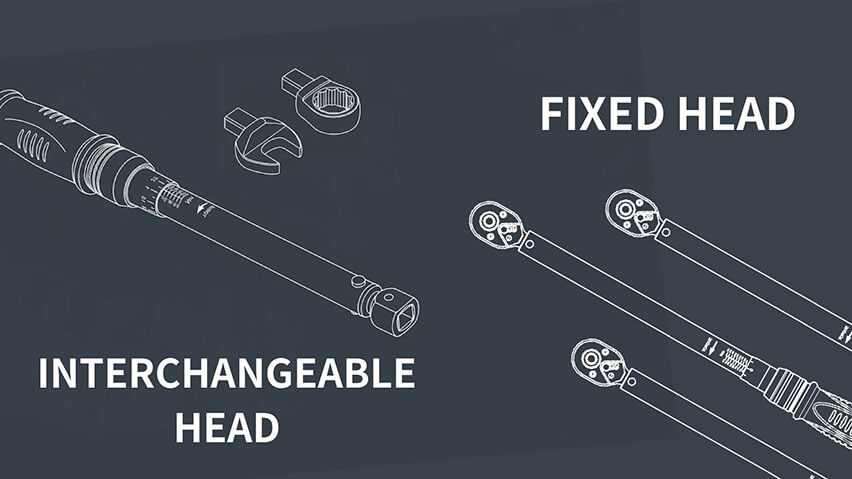
A fixed head torque wrench features an integrated, non-removable head—typically a square drive (ratchet) or a fixed spanner. The wrench body and the head are manufactured as a single, cohesive unit.
Strategic Advantages for End-Users
- Structural Integrity: Because there are no moving connection points between the head and the body, fixed head wrenches are incredibly robust. They excel in heavy-duty applications where maximum torque application and durability are paramount.
- Simplicity and Speed: For assembly line workers who deal with the exact same fastener size hundreds of times a day, a fixed head wrench offers unparalleled efficiency. There is no need to swap heads or double-check connection secureness.
- Lower Initial Cost Per Unit: Generally, a standalone fixed head torque wrench is more cost-effective to manufacture and purchase than a comparable interchangeable model with multiple heads.
Limitations in the Field
- Lack of Versatility: A 1/2" drive fixed ratchet wrench can only accept 1/2" sockets. If a technician encounters a unique fastener that requires an open-end or ring-head application, they must retrieve an entirely different torque wrench.
- Broader Product Line Requirements: To meet different market needs, brand owners or importers may need to carry a wider range of complete wrench models with different drive sizes and torque ranges.
The Versatility of the Interchangeable Torque Wrench
What is an Interchangeable Torque Wrench?
An interchangeable torque wrench consists of a standardized handle and mechanism body with a specialized female receptacle (commonly 9x12mm or 14x18mm rectangular fittings). This allows the user to click in various attachments, such as open-end, ring, flare-nut, or standard ratchet heads.
Strategic Advantages for End-Users and Buyers
- Ultimate Adaptability: This is the "Swiss Army Knife" of torque control. A single wrench body can service brake lines (using a flare-nut head), standard bolts (using a ratchet head), and tight clearance areas (using an open-end head).
- Cost-Efficient Calibration: Torque wrenches require regular calibration. For a facility manager, calibrating one interchangeable wrench body is significantly cheaper and faster than calibrating five separate fixed wrenches.
- More Efficient Product Planning: Instead of developing or sourcing a large number of complete wrench models, brand owners and importers can build a more flexible product range around several wrench bodies and a variety of interchangeable head attachments. This helps reduce SKU complexity and improves product line planning.
Limitations in the Field
- Higher Initial Investment for End-Users: Purchasing the wrench body plus a set of heads can have a higher upfront cost for the consumer compared to buying a single fixed wrench.
Side-by-Side Sourcing Comparison
To assist procurement teams in making data-driven decisions, we have compiled a comparison matrix highlighting the core differences from a buyer’s perspective.
| Feature / Metric | Fixed Head Torque Wrenches | Interchangeable Torque Wrenches |
| Primary End-User | Assembly lines, single-task mechanics, heavy construction. | Mobile technicians, EV mechanics, aerospace, HVAC. |
| Versatility | Low (Single function/drive size). | Extremely High (Accepts open-end, ring, ratchet, etc.). |
| Product Line Complexity | High (Requires stocking many entire wrench SKUs). | Low (Stocking fewer bodies, more compact attachments). |
| End-User Calibration Costs | High (Must calibrate every single wrench individually). | Low (Only the main torque wrench body needs calibration). |
| Initial Purchase Price | Lower per individual tool. | Higher initial setup, but superior long-term ROI. |
| Sourcing Strategy Focus | Volume sales to large-scale production facilities. | Value-added selling, customizable kits for specific trades. |
How Brand Owners and Importers Can Optimize Their Product Line
For brand owners, importers, and OEM/ODM buyers, the product line is one of the most important business assets. During the procurement evaluation phase, customers are assessing whether your product lineup can solve their specific engineering problems efficiently. Here is how you can leverage both types of wrenches:
- Implement a Hybrid Sourcing Strategy
Do not limit your product line to just one type. Offer fixed head wrenches for customers in heavy industry and high-volume manufacturing lines where repetitive tasks are the norm. At the same time, position interchangeable systems as premium, problem-solving kits for field service technicians and specialized mechanics. - Leverage Custom Branding and OEM Solutions
The market is highly competitive. One of the best ways to secure customer loyalty is by offering tools under your own trusted brand name. Partnering with a specialized manufacturer allows you to create a proprietary line of tools. By investing in a high-quality OEM torque wrench program, you can define the specifications, handle designs, and packaging, ensuring your product stands out in a crowded marketplace while maintaining stronger brand value. - Educate Your Buyers
Train your sales team to ask the right questions. When a customer requests a quote, ask them: "Are your technicians performing repetitive tasks, or are they moving between different types of fasteners?" Guiding them to the right product establishes your business as an industry expert, not just a supplier.
Frequently Asked Questions (FAQ) for Torque Wrench Procurement
To further support your purchasing decisions and address the most common queries from industry professionals, we have compiled the following FAQ.
Q1: Which type of torque wrench offers better ROI for multi-disciplinary workshops?
A1: An interchangeable torque wrench provides a significantly higher Return on Investment (ROI) for multi-disciplinary workshops. Because a single wrench body can accept dozens of different heads (ratchet, open-end, ring), workshops save money on initial tool purchases and drastically reduce annual calibration costs.
Q2: Does an interchangeable torque wrench compromise on torque accuracy?
A2: No. High-quality interchangeable torque wrenches maintain the same industry-standard accuracy as fixed head models. The precision lies within the internal spring and cam mechanism of the handle, not the detachable head.
Q3: What are the maintenance differences between fixed and interchangeable head wrenches?
A3: Fixed head wrenches require basic cleaning and regular calibration. Interchangeable wrenches require the same, plus occasional cleaning of the connection joint (such as the 9x12mm or 14x18mm cavity) to ensure debris does not prevent the attachment from clicking securely into place. Both types must always be stored at their lowest torque setting.
Q4: How should buyers choose between fixed and interchangeable models?
A4: Buyers should base their selection on their target market and application focus. If the primary demand comes from automotive assembly plants or repetitive production work, fixed head wrenches are often the more practical choice. If the target users are field technicians, HVAC installers, or aerospace mechanics, interchangeable models can offer greater flexibility and space-saving advantages.
Q5: Can we customize torque wrenches for our specific brand or market needs?
A5: Yes. Partnering with a qualified manufacturer allows B2B buyers to utilize OEM and ODM services. You can customize torque ranges, handle colors, branding, and even specific interchangeable head assortments to better match your target market’s needs.
About Torque-Tech: Your Reliable Manufacturing Partner
When evaluating your supply chain, your success relies on the quality, reliability, and innovation of the products you bring to market. At Torque-Tech Precision Co., Ltd., we have spent over two decades engineering high-precision torque tools in Taiwan, earning a global reputation for manufacturing excellence.
Our facility is equipped to support your sourcing and product development goals. Whether you are looking to expand your product range with our versatile interchangeable torque wrench series, or seeking a reliable OEM/ODM torque wrench partner to develop a custom-branded line of tools, we have the production capacity and R&D expertise to support your plans.
We do not just manufacture tools; we help customers develop practical torque tool solutions for their target markets. If you are ready to strengthen your product line and bring greater value to your customers, our team is ready to assist you.
Please contact us today to discuss your sourcing needs, request a sample, or explore our OEM/ODM torque wrench capabilities.



